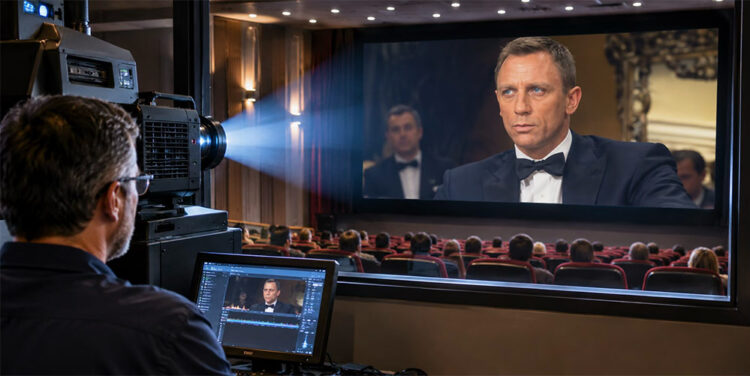
On 2 October, Casino Royale returned to cinemas for its twentieth anniversary. Park Circus had announced the screenings on 16 September, together with a new 4K Digital Cinema Package, artwork and a trailer. The opening came three days before James Bond Day. The film’s cards, chips and green felt recall casino imagery found in titles under casino game pakistani, while director Martin Campbell uses those details to build the encounter between Bond and Le Chiffre. Craig’s Bond debut reached cinemas in November 2006. The anniversary run brings Phil Méheux’s photography back to a full-size cinema screen.
A New Cinema Copy, Not a New Restoration
A DCP is the file used for digital cinema projection. Park Circus announced a 4K version for the anniversary, without reporting a new restoration of the original negative. Casino Royale was shot on 35mm, with its framing already intended for cinema screens.
The BFI’s film record lists a running time of 144 minutes. The film moves between wide outdoor scenes, crowded rooms and close shots of the actors’ faces. Screenings began on 2 October, but cinemas followed their own screening schedules.
Why Craig’s First Bond Feels Different
Campbell introduces a Bond still learning how to carry himself. Craig’s early scenes favour physical movement over effortless charm, and the black-and-white opening gives the character a rough beginning. His sharp suit looks almost unfamiliar by the time he reaches the formal casino rooms. The shift is visible in Craig’s posture, not only his clothes.
Bond meets Vesper Lynd, played by Eva Green, on a train. She studies his suit and makes a few sharp remarks, which Bond answers with his usual dry humour. Their conversation moves quickly, with little time for pleasantries. Later, at the poker table, Mads Mikkelsen’s Le Chiffre barely moves. He watches the cards, looks across at Bond and waits for the next move. Campbell keeps the camera close to the players, catching small gestures that might go unnoticed in a wider shot. These scenes are a sharp contrast to the film’s earlier chases.
How the Poker Scenes Were Shot and Edited
Cinematographer Phil Méheux and editor Stuart Baird faced a practical problem: several people sitting at one table, each with a hand of cards, but no obvious movement to follow. Méheux told the American Society of Cinematographers that the cast spent a full day rehearsing the scenes and testing positions. One game was shot with a stationary camera. Another used movement around the table, while a third slowly pushed in towards Bond and Le Chiffre. That rehearsal kept the geography of the room clear when the camera moved from a wide view of the table to one player’s reaction.
Baird holds on a player’s face before showing the cards, then returns to the table as another wager goes into the pot. In Hold’em, a call matches the current bet, a raise increases it, and a fold ends that player’s part in the hand. Those actions change the stakes while everyone stays seated and the camera stays close. The edit decides when the audience learns what is happening.
| Element | Detail visible on a cinema screen |
|---|---|
| Picture | New 4K DCP prepared for projection |
| Photography | Static shots mixed with moving cameras |
| Editing | Cards revealed after a character reacts |
| Sound | Quiet dialogue interrupted by sudden action |
The Final Hand and Its Unusual Odds
Fleming’s novel gives Bond baccarat; the film switches to Texas Hold’em. Each player receives two private cards, while five shared cards appear face-up in stages. Betting rounds allow players to check, bet, call, raise or fold. If more than one remains at showdown, the strongest five-card hand takes the pot.
The final hand gives four players unusually strong combinations. Researchers Jay Falletta and Stephen Woodcock studied the scene in 2018 and estimated that four players all holding a flush or better would occur in fewer than 0.03% of comparable four-player games. The card rankings are consistent, but the combination is exceptionally rare. The film saves Bond’s winning hand for the final reveal.
Three editing choices make that reveal work:
- The camera stays on faces while cards remain unseen.
- The growing pot gives each exchange a visible consequence.
- The last hand appears only after the other players show theirs.
The Craft Behind the Anniversary Screening
Back on a cinema screen, the small pauses around the table are easier to notice. Méheux’s close shots catch a glance across the felt; Baird waits before cutting to the next hand. Craig’s Bond can fill the frame without a speech. Twenty years after its first release, those quiet moments still sit comfortably beside the film’s action scenes.